+447946739882, +2348151453146
  INFO@CHESSSUBSEAENGINEERING.ORG








Description
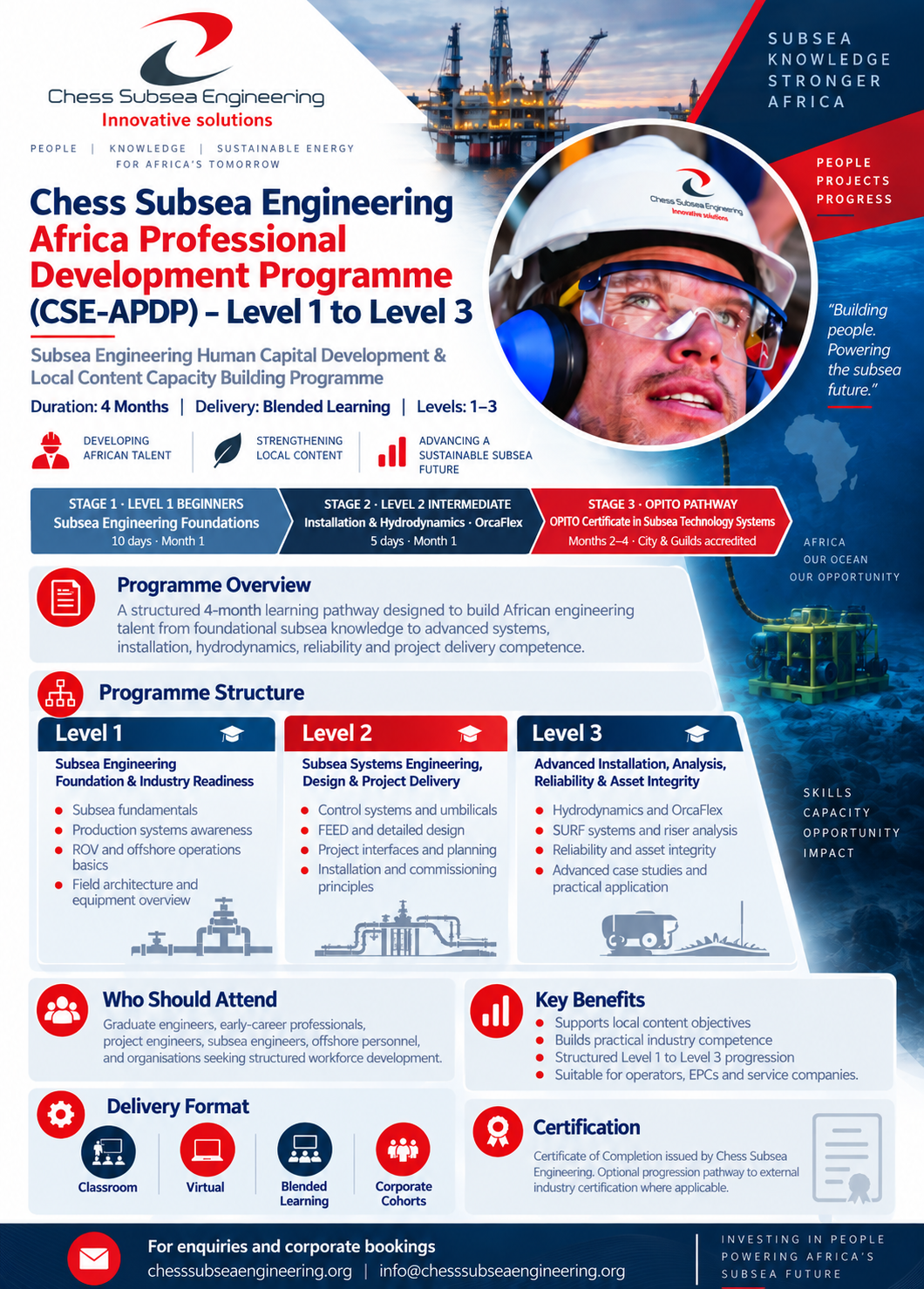
The CSE-APDP is a structured 4-month subsea engineering development programme covering the project lifecycle from concept selection and FEED through design, installation, commissioning, IMR and decommissioning.
Delivered through Blended or Virtual Learning, the programme combines technical instruction, case studies, practical exercises, software-based learning and assessments to develop competent, industry-ready subsea professionals.
Course Outlines
Phase 1 – Month 1: Chess Subsea Engineering Technical Training unit and full certificates
Duration: 15 Training Days
Delivery: Blended or Virtual Learning
Structure: Stage 1 – Level 1 Beginners + Stage 2 – Level 2 Intermediate
Subsea Engineering Beginners Master Class (SEBMC)
Provides the foundation for understanding offshore and subsea production systems and their interfaces. Key areas include:
- Subsea production systems and field architecture
- Subsea distribution systems
- Offshore and subsea surveys
- Wellheads, Xmas trees, manifolds, pipelines, flowlines and risers
- Subsea structures, installation vessels and equipment
- Subsea control systems and power supply
- Project execution and interface management
- ROV intervention, interface requirements and tooling
- Pre-commissioning, commissioning and decommissioning of subsea systems and offshore structures
Engineering of Deepwater Subsea Control Systems Architecture & Umbilical (EDSCSAU)
Develops understanding of subsea production control architecture and umbilical systems, including:
- Subsea control-system principles and architecture
- Topside and subsea control components
- Subsea control modules (SCM)
- Umbilical systems and chemical injection
- Control-system selection criteria
- Valve actuation and choke operation
- Production control-system operation
- Subsea control-system interfaces and operational mechanisms
Deepwater Offshore & Subsea Operations Engineering Project Design & Planning (DOSOEPDP)
Develops capability across subsea project engineering and delivery, including:
- EPC concept selection and FEED
- Subsea production systems and flow assurance
- Pipeline FEED and detailed engineering
- Material, coating and wall-thickness considerations
- Pipeline stability, expansion, thermal buckling and protection
- Project roles and responsibilities
- Interface matrix, interface register and management procedures
- Offshore EPIC project interface architecture
- Fabrication and installation
- Pre-commissioning and commissioning
- Tie-ins and protection systems
Subsea Structures Installation & Hydrodynamics Analysis with OrcaFlex (SSIHA)
Introduces participants to practical subsea installation engineering and dynamic analysis using OrcaFlex, covering:
- Hydrodynamic engineering principles
- Riser systems and selection
- Vessel motions and environmental loading
- Mooring systems
- SURF systems — subsea umbilicals, risers and flowlines
- Static and dynamic analysis
- Fatigue and VIV analysis
- OrcaFlex modelling environment and simulation objects
- Model setup, analysis and interpretation of results
- Practical OrcaFlex workshops including riser modelling and installation analysis
Phase 1 Outcome
At the end of Month 1, participants will have developed a strong foundation across subsea production systems, controls, project engineering, installation and hydrodynamic analysis, preparing them to progress into the OPITO Stage 3 Certificate in Subsea Technology Systems pathway during Months 2–4.
Phase 2 – Months 2–3: OPITO Stage 3 Certificate in Subsea Technology Systems
Subsea Equipment & Tools
Materials Technologies, Subsea Systems & Flow Assurance
ROV Systems
Subsea Controls
OPITO enrolment, tuition and examinations across all four units
Phase 3 – Month 4: Finalisation, Competency Assessment & Certification
Consolidation workshops
Competency assessment
OPITO resits where required
Issue of OPITO unit certificates
Issue of the full OPITO Stage 3 Certificate in Subsea Technology Systems for successful candidates
End-of-programme competency reporting
Assessment
Participants will be assessed throughout the 4-month CSE-APDP programme using a combination of quizzes, short-answer and multiple-choice assessments, practical exercises, case studies, software-based workshops and competency reviews.
Assessment will cover key areas including subsea engineering fundamentals, control systems, project design and planning, ROV operations, installation engineering, hydrodynamics and OrcaFlex applications.
During the OPITO phase, candidates will also complete the required unit examinations and competency assessments. Final results will contribute to an end-of-programme competency report, highlighting each participant’s knowledge, practical capability and readiness for subsea engineering roles.
Outcome
Participants will gain a practical and industry-focused understanding of subsea engineering systems, controls, project design, installation, ROV operations, hydrodynamics, OrcaFlex analysis, reliability and asset integrity.
On completion of the 4-month CSE-APDP programme, participants should be able to apply the knowledge gained with reduced supervision and contribute effectively within operators, EPC contractors, subsea service companies, installation contractors and offshore project teams.
Professional Certificate
Upon successful completion of the programme, participants will receive a Certificate of Completion issued by Chess Subsea Engineering for the CSE-APDP pathway.
Candidates who successfully complete the OPITO units and examinations will also receive the applicable OPITO unit certificates and, on successful completion of all required units, the OPITO Stage 3 Certificate in Subsea Technology Systems.
How to Register
Click here to download registeration booklet on msword and email completed booklet to info@chesssubseaengineering.org directly.